|
ARTICLES
[an error occurred while processing this directive]
|
Although I’ve always enjoyed flying 049 size airplanes, one thing I don’t like is the short flight time that you get from a standard Cox .049 engine with an integral fuel tank. The logical solution to this problem is to use a “product engine”. A product engine is one of those engines found on the plastic airplanes that Cox used to sell millions of. They come with a plastic backplate with mounting holes and an external fuel nipple for use with a remote tank. For this project I built a Q-Tee and used a product
engine I
got from eBay, and a one
ounce Perfect metal fuel tank. I soldered forward pointing brass
extension tubes to the tank and drilled holes in the fuselage with the
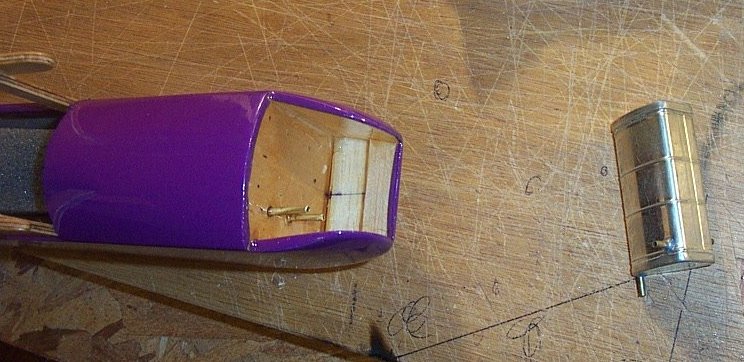
correct spacing to match the tubes. Here’s a photo of one tank in its
unaltered form, and the fuselage with the other tank already installed.
To get the brass lines through the holes, I inserted a
1/16″
wire
through one hole into the radio compartment, then stuck the brass tube
over the end of the wire. When I pushed the tank into the tank
compartment, the 1/16″ wire led the tube right through the hole. Then
all I had to do was rotate the tank slightly to get the other tube
through. Then I epoxied both tubes right into the firewall for an
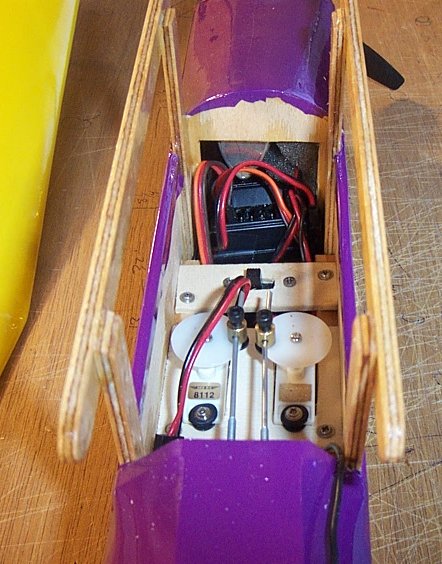
oilproof installation. Here’s the tank as seen from the radio
compartment. You can just barely see it above the receiver.
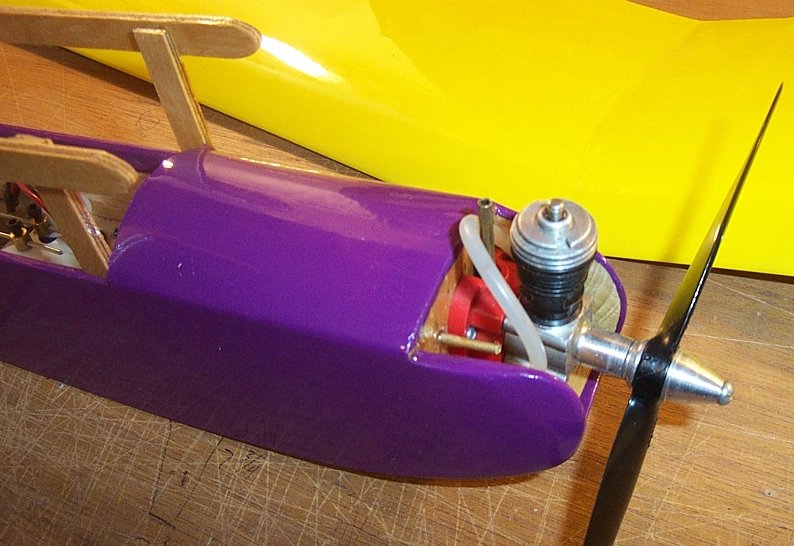 The engines with integral tanks make the incoming air
charge
go through a tiny tube, which robs the engine of power. The
product engine backplate actually increases performance by having a
shorter air induction path. I originally had a Black Widow
cylinder on this engine, which has dual bypass ports. You may
notice that I like to build Q-Tees without landing gear for a better
glide after the engine dies. The lack of landing gear combined
with the high power engine made this a terribly overpowered airplane
that I didn't much enjoy flying. So I took off the dual port
cylinder and piston and replaced them with a set from a single port Cox
engine. I also put on a less efficient black Cox propeller. After
all of this fine tuning, this plane turned into a really nice
flier. Here’s the radio compartment. The Q-Tee is a nice little
plane
for
learning to build from scratch, and it’s a great subject for
experimenting with design modifications. Be sure to check out my
other Q-Tee article about building swept back wings to make it easier
to get the center of gravity right. 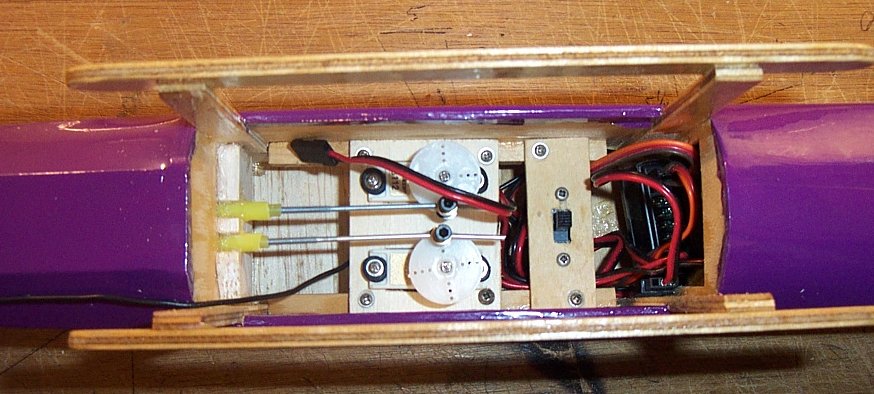 |